Turn TEAS Practice Questions into Focused Revision
Practice questions are most useful when you learn from the reasoning behind each answer, not just the score. If you are asking how do I use practice questions to prepare for the TEAS test, start with a repeatable cycle: answer, review, name the skill, then practise that skill again.
This approach can help you decide what to study next across reading, math, science, and English and language usage. Use the steps below in your next study session, whether you are following a longer plan or preparing in the final week.
Set up a useful mixed-practice session
The cumulative practice set gives you questions across all four TEAS areas. Before you begin, choose whether to use the timed option, prepare scratch paper, and put away notes and search tools. If an item is taking too long, mark it for review, make your best choice, and continue through the set.
Before checking the answers, note which questions felt uncertain, where you changed your mind, and whether you had to reread wording. These details will help you review your process, not just count correct answers.
- Record your time and any pacing changes.
- Mark missed, guessed, and uncertain items.
- Read explanations even for answers you got right.
The instructions for the mixed-practice exercise are on page 103.
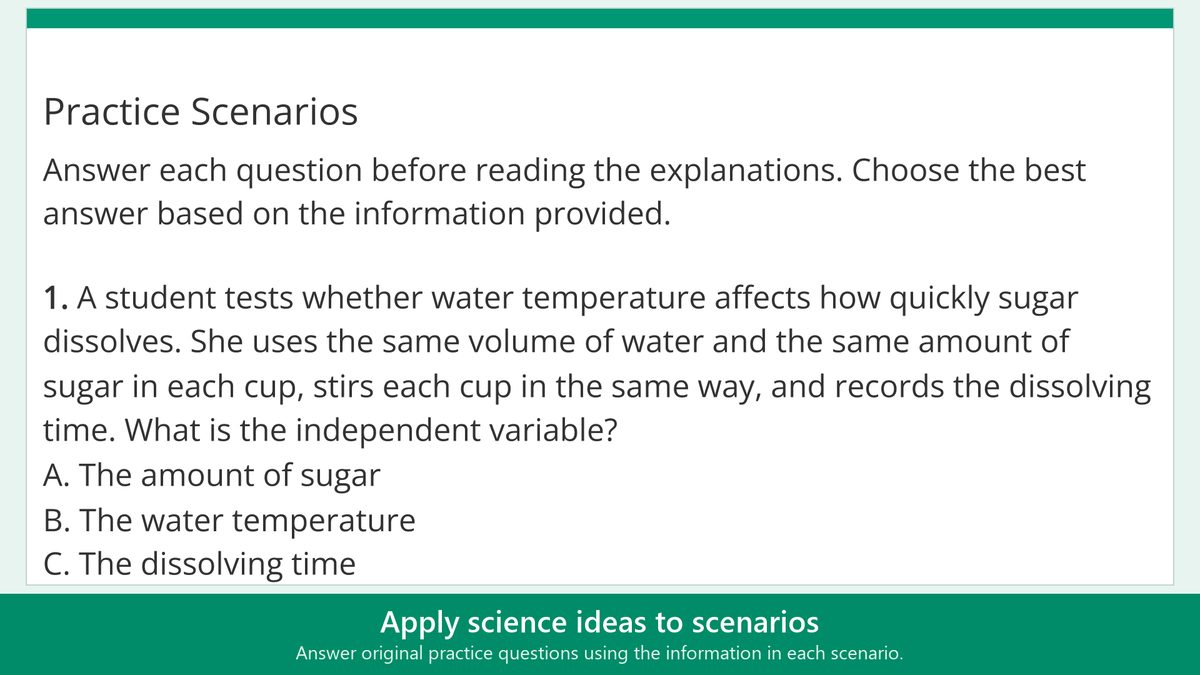
Use explanations to find the reason behind a miss
A wrong answer can point to different next steps. You may have missed a fact, misunderstood what the question asked, chosen the wrong operation, made a calculation slip, or spent too long deciding. For each missed, guessed, or uncertain item, compare your reasoning with the explanation and name where your approach stopped working.
Looking at a score alone will not tell you what to do next.
That sentence appears on page 14. The guide recommends describing a specific skill or error so you can choose an action. For example, distinguish a unit-conversion gap from a general feeling that math is difficult. A correct guess also deserves review: check whether you can explain why the best answer fits.
Make the score-and-review worksheet actionable
After the cumulative set, use the worksheet to record correct answers by area and your total, then list every missed, guessed, or uncertain question with its area. The practice score is for review, not an official TEAS score. Add your start and finish times if you used a timer, along with any pacing notes.
Next to each question, write a short reason for reviewing it and a specific follow-up task. Keep the entry useful enough to guide your next session, rather than writing only that you need to study science or reading.
- Content gap: return to the relevant explanation and restate the rule in your own words.
- Process error: practise the same skill while checking how you read, calculate, or manage time.
- Uncertain answer: explain why the best choice works and why alternatives do not.
The worksheet appears on page 115, with further review guidance on page 117.
Practise this review cycle in your next session
Set aside one study block to turn a small group of review items into targeted practice. Start by choosing two or three skills from your worksheet. For each one, revisit the relevant section, cover the explanation, and try to state the idea or method in your own words. Then answer a few related questions and explain your reasoning.
- Identify the skill behind each missed or uncertain answer.
- Sort the cause as a content gap, a process error, or both.
- Choose one focused task, such as showing units through a conversion or locating passage evidence for a main idea.
- Check whether your reasoning improved on a different question testing the same skill.
This gives your practice a clear stopping point and a next step. Page 119 advises using a different item for a stronger check, since a repeat score can look better simply because the questions are familiar.
Fit focused review into your study schedule
A study plan for TEAS exam preparation needs both a time plan and a way to choose what to study. Your calendar answers when; your diagnostic results and review notes help answer what. At the start of a week, select a few priority skills and assign them to available study blocks. At the end, note what you practised and choose the next steps.
Whether you use a 4 week TEAS study plan or a TEAS 6 week study plan, adapt the number and length of sessions to your available time. A TEAS study planner can help you keep sessions manageable. For how do I make a 4 week TEAS study plan, begin with your exam date and available blocks, then schedule focused review and mixed practice. If you wonder how should I plan my TEAS study schedule, include time to check official exam information separately.
To decide what should I study first for the TEAS test, look for recurring skills in your notes, not only the lowest section score. To answer how can I balance reading math science and English TEAS review, use mixed practice to spot needs across all four areas, then give focused blocks to the skills that need attention.
What the study guide includes and who it is for
ATI TEAS Study Guide: Build Test-Day Confidence by Dana Mercer is an independent, printable 136-page PDF in US Letter size, with clickable bookmarks and a linked Contents page. It is an independent study aid, not an official ATI publication or an ATI-endorsed resource. Its practice questions are original, not actual exam questions, and it does not guarantee a score or admission. Confirm current exam details with ATI.
The guide includes a study plan, one review chapter for each TEAS area, worked examples, original practice questions with explained answers, review checklists, a cumulative set, a score-and-review worksheet, and a final-week plan with test-day strategies. It is for nursing-school and other health-program applicants, and tutors or instructors supporting them. It is not for people seeking official, real, or leaked exam questions, a guaranteed score, or preparation for another exam. One tutor or instructor may print copies for up to 10 students in one class or tutoring group.
Get the study guide to use the full review and practice sequence, or start with the free Reading chapter sample, pages 1–39.
Frequently asked questions
How do I use practice questions to prepare for the TEAS test?
Answer the questions, review every explanation, and record missed, guessed, or uncertain items. Identify the skill and reason behind each one, then practise that skill again with a different question when possible.
What should I study first for the TEAS test?
Use a diagnostic and your review notes to identify specific skills that need attention. A recurring difficulty can be a useful priority, while one score alone may not explain what to practise.
How can I balance reading math science and English TEAS review?
Use mixed practice to notice needs across all four areas, then assign focused study blocks to the skills your answers reveal. Keep your plan manageable and adjust it as you review more questions.
Does the guide include official ATI questions?
No. It is an independent study aid, and its practice questions are original rather than actual exam questions. Confirm current exam details with ATI.
Can I try part of the guide first?
Yes. The Reading chapter, pages 1–39, is available as a free sample. The complete guide is a printable PDF with reviews and practice across reading, math, science, and English and language usage.
ATI TEAS Study Guide: Build Test-Day Confidence: Clear reviews of all four TEAS areas, original practice questions, and explained answers to strengthen readiness for test day.
$15 introductory price until Fri 23 Oct 2026, 4:59 pm ET (then $19). Instant PDF download.
Get the study guide ($15)Try Reading chapter free
Tutoring or teaching a class? Tutor and classroom license ($49): one tutor or instructor may print copies for up to 10 students in one class or tutoring group.